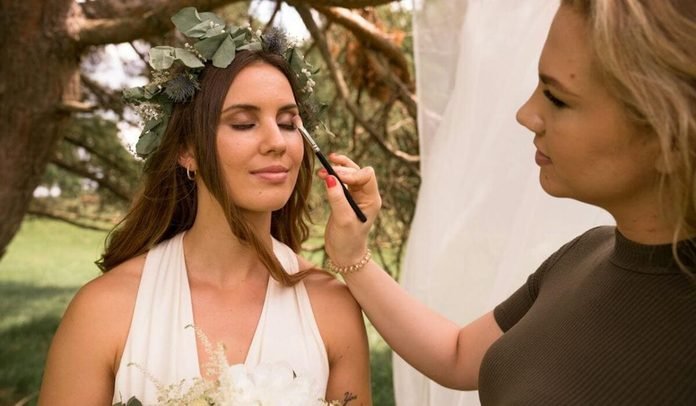
A wedding morning can look calm in photographs while feeling strangely crowded in real life. Five people are scheduled for beauty services, breakfast is balanced beside curling irons, family members keep opening the door, and the bride’s “quiet moment” has become another event with a photographer, videographer, and six attendants watching.
The solution is not waking everyone earlier. A good morning timeline works backward from the moment the bride must be completely dressed and ready to move. It gives professionals a functional room, places food where people can eat it, limits the number of emotional reveals, and assigns practical questions to somebody who is not in the makeup chair.
The example in this guide uses a 5 p.m. ceremony and a 2:45 p.m. first look, but the method works for any start time.
The beauty team and photographer should provide the final service and image timings for the people, looks, locations, and coverage actually booked.
Begin with the “fully ready” time
The ceremony time is too distant to organise the morning. Start with the first event that requires the bride to be fully dressed: first look, pre-ceremony portraits, transport departure, or ceremony staging.
If the first look begins at 2:45, the bride may need to leave the suite at 2:35. Before that she needs a dressing and accessory window, a short comfort check, final touch-ups, and perhaps a quiet minute. Hair and makeup therefore cannot finish at 2:35.
A useful backward sequence might be:
- 2:45 p.m.: first look begins
- 2:35 p.m.: bride leaves the room
- 2:25 p.m.: final touch-up and personal pause
- 1:45 p.m.: dressing begins
- 1:30 p.m.: hair and makeup fully complete
The half-hour between beauty completion and dressing is not automatically available for another reveal. It absorbs a final adjustment, gives the room time to clear food and equipment, and lets the bride use the bathroom before the outfit goes on.
Let the beauty team calculate the first start
Count services, not people. One attendant receiving hair and makeup requires two service slots. Another having makeup only needs one. The bride’s look may take longer than an attendant’s, and textured hair, extensions, intricate styling, airbrush work, lashes, or elaborate accessories can change timing.
Ask the lead artist for:
- Duration of each booked service
- Number of services that can happen at the same time
- Setup and pack-down time
- Preparation expected from each person
- Who places the veil, headpiece, or hair accessories
- Touch-up time required after dressing
- The latest safe completion time for the bride and photographed attendants
Do not calculate the start by multiplying an average from the internet. Artists work at different speeds and may organise services in a particular order. A trial can also reveal that the bridal look requires more or less time than expected.
Put the bride in the safest service position
Automatically placing the bride last creates a fragile schedule. If an earlier client is late or a service runs long, the delay lands on the one person whose dressing and portraits cannot be skipped.
Finishing first is not always ideal either. Hair and makeup may need more touch-up after several hours, and the bride can spend the morning waiting while everyone else receives services.
Many teams place the bride in a middle or later-middle position, with enough time afterward for small corrections.
Follow the lead artist’s recommendation. The safer question is not “When does the bride want to sit?” but “Which position protects her completed time without leaving her finished for half the day?”
A sample beauty service grid
This example assumes one hair artist and one makeup artist, four attendants receiving both services, and the bride receiving both. The times are illustrative; the booked team should build the real grid.
| Time | Hair chair | Makeup chair | Room action |
|---|---|---|---|
| 8:15 a.m. | Artist setup | Artist setup | Breakfast is ready away from stations |
| 8:45 a.m. | Attendant 1 | Attendant 2 | Next clients are present and prepared |
| 9:30 a.m. | Attendant 2 | Attendant 1 | Room contact handles deliveries and messages |
| 10:15 a.m. | Attendant 3 | Attendant 4 | Bride eats and follows preparation instructions |
| 11:00 a.m. | Attendant 4 | Attendant 3 | Lunch delivery is received and labelled |
| 11:45 a.m. | Bride | Makeup artist breaks or completes corrections | Photographed details are gathered |
| 12:30 p.m. | Hair artist breaks or completes attendants | Bride | Photographer arrives; open food begins clearing |
| 1:30 p.m. | Final checks and accessory plan | Final checks and touch-up plan | Attendants dress; bride receives quiet reset |
This grid deliberately avoids booking every artist minute without a break. Changeovers, cleaning, adjustments, and food still exist. A professional team may build the pattern differently or recommend another artist to shorten the morning.
Give the room four clear zones
Set aside a beauty area with stable chairs, approved power access, work surfaces, and enough light. Protect a separate bright corner for dressing and photographs. Put bags, coats, and spare shoes in a drop zone. Keep food and water on a wipeable surface away from garments and hot tools.
This matters more than matching robes or decorative drinkware. A photographer can work with an ordinary hotel suite. She cannot create a clean dressing photograph while eight open suitcases and breakfast containers occupy every surface.
Ask the beauty team what furniture and power the room must supply.
For a large party, send a photograph or floor plan. The team may recommend another room or additional table rather than improvising around one small desk.
Name the three people who make the morning work
The room contact holds the key, meets vendors, receives food, and answers access questions. The timekeeper knows the service grid and makes sure the next person is ready. The personal attendant stays close to the bride, knows the outfit and bag plan, and protects her from operational questions.
One person can hold two roles for a small wedding. Do not give all three to the bride or to one maid of honour who is also receiving full hair and makeup, caring for a child, and appearing in every photograph.
Put their numbers on the relevant vendor schedule. A florist asking where to leave personal flowers should not be routed to the bride because her number appeared on an early contract.
Give phones and visitors a boundary before the room fills
Choose one operational phone held by the room contact or coordinator. It carries vendor numbers, access notes, the service grid, transport details, and the current timeline. Vendors should call that number rather than the bride’s.
Mute general group chats and direct guest questions to a family contact or website.
A charged phone does not help if it turns the bride into a morning help desk. Her device can remain available for personal messages, music, or photographs without receiving every parking question.
Set visiting hours for relatives and friends who are not getting ready in the room.
A ten-minute visit after attendants dress is easier to host than a steady stream of people bringing bags, drinks, and questions while artists are working.
Schedule breakfast and lunch where they can be eaten
Breakfast should arrive before the first service or during a deliberate gap. Lunch should come before attendants dress and before open food needs to disappear from photography areas.
Name who orders, confirms, receives, labels, and clears each delivery. Ask guests and the booked team for any required food information in advance. Choose familiar options that work in the room; a hot buffet may bring steam, serving equipment, and cleanup into a small suite.
The bride needs a defined eating time rather than a plate placed beside her while an artist works.
In the sample grid, she can eat breakfast before 10:15 and lunch before her 11:45 hair service. The actual schedule should mark her pause just as clearly as her appointment.
Let getting-ready photographs begin after the room has settled
The first hours of beauty services are often visually repetitive and operationally busy.
A photographer may not need to arrive at the first brushstroke. Coverage can begin when details are ready, several attendants are nearly finished, and the bride is entering her final services.
Ask what the photographer wants available: outfit, rings, invitation pieces, shoes, jewellery, fragrance if used, heirlooms, and vow books. Put them in one place with a named attendant. Remove tags and untangle chains the night before.
Detail photographs should not separate valuable items from their owner for hours. Record the handoff and return rings, sentimental jewellery, and documents immediately after use.
Plan the other partner’s morning with the same care
The partner not using the main beauty suite still needs a room, food, clothing check, personal items, transport, and a photography call. “Gets ready at 1 p.m.” is not enough if cuff links are across town and the photographer expects to cover both locations.
Give that room its own contact and departure owner.
Confirm when flowers, letters, rings, or gifts move between the two sides.
Avoid using the same photographer for simultaneous dressing unless the rooms are close and the coverage plan is realistic.
If one partner wants a quiet morning with one friend rather than a staged group scene, preserve that.
Symmetrical photographs are not required for the experience to be equally considered.
Choose quiet moments instead of collecting them
A letter exchange, parent reveal, bridesmaid reveal, prayer, gift opening, private vows, and champagne toast can each be meaningful. Scheduled together, they can make the bride perform a fresh emotional reaction every fifteen minutes.
Choose one or two that reflect the relationships involved. Give them enough time and privacy. A parent reveal may need ten quiet minutes; it does not need a semicircle of spectators unless the bride wants that.
Quiet can also be unscripted. Protect fifteen minutes after beauty services when visitors leave, the bride eats or sits alone, and nobody asks her to react. This may never appear in the gallery. It can still be one of the most valuable parts of the morning.
Give dressing its own private block
Use the bathroom first. Put on all base layers. Then bring in the named helper who understands buttons, corsetry, draping, jewellery, or traditional clothing. The helper should already be dressed and should have watched any fitting video.
A simple outfit may need twenty minutes. Intricate or layered clothing can need 45 minutes or more.
Add shoes, veil, headpiece, final touch-up, and a movement check rather than declaring the bride ready when the last fastening closes.
Photography can cover selected parts without turning the entire room into an audience. Friends can return for a reveal once the bride feels secure. This preserves genuine privacy and gives the photographer a cleaner scene.
The sample morning from wake-up to first look
| Time | Main action | Detail that keeps it calm |
|---|---|---|
| 8:00 a.m. | Room contact wakes, checks the key, and opens the suite | The bride does not begin her morning with vendor access |
| 8:15 a.m. | Artists set up; breakfast is received | Food and beauty stations use different surfaces |
| 8:45 a.m. | First services begin | The next clients remain in the room and ready |
| 10:15 a.m. | Bride finishes breakfast and personal preparation | No vendor email or room-management tasks reach her |
| 11:00 a.m. | Lunch arrives; finished attendants eat first | The room contact labels meals and begins clearing by noon |
| 11:45 a.m. | Bride begins hair | Photographed objects are gathered without involving her |
| 12:30 p.m. | Bride begins makeup; photographer arrives | Open food and spare luggage leave the dressing area |
| 1:30 p.m. | Beauty is complete; attendants dress | Bride receives a quiet reset rather than another activity |
| 1:45 p.m. | Bride uses the bathroom and begins dressing | Only the chosen helper and photo team remain |
| 2:20 p.m. | Accessories, touch-up, movement check, and optional reveal | The reveal is skipped if dressing used the available time |
| 2:35 p.m. | Bride leaves with personal attendant | Bags and room cleanup already have other owners |
| 2:45 p.m. | First look begins | The morning ends without a sprint |
When the morning needs to start earlier
A larger service count, one artist, salon travel, intricate cultural dressing, separate getting-ready locations, an early first look, or extensive pre-ceremony portraits can all move the start.
Add real door-to-door time for salon appointments; the service ends before payment, gathering belongings, travel, parking, and re-entering the suite.
Ask if more artists can preserve a reasonable wake-up time. There is a practical point at which another professional adds more calm than another hour before sunrise.
Salon appointments require a different calculation
A salon can provide purpose-built lighting, chairs, mirrors, and several professionals. It also adds payment, packing, transport, parking, and the risk that one late appointment delays everyone travelling together.
Ask when the group will be completely finished and free to leave—not when the last service is expected to end. Add time to gather belongings, settle the account, load vehicles, drive, park, and re-enter the dressing location. Keep the main outfit at the dressing venue rather than carrying it through a busy salon unless the plan genuinely requires otherwise.
If the photographer covers salon preparation, decide if that travel is worth using contracted coverage. The final dressing room may offer more personal images and fewer strangers in the background.
When the morning can start later
A small party, fewer professional services, no pre-ceremony portraits, simple attire, and one venue may shorten the schedule. Do not keep a long morning because bridal content suggests one is required.
Use the time saved for sleep, breakfast, a walk, or an ordinary few hours with close people.
Empty early time does not need to be filled with matching-outfit photographs and repeated toasts.
Complete a handoff before the bride leaves the room
Five minutes before departure, the personal attendant confirms that the bride has her flowers if needed, vow book, phone or personal bag, comfortable transport arrangement, and any item required immediately at the next location. The coordinator confirms rings and marriage documents through their separate owners.
The room contact takes responsibility for luggage, leftover food, garment packaging, keys, and checkout. The emergency kit travels with its named carrier. Nobody asks the bride from the lift whether she wants the steamer packed.
Use a short spoken check rather than reopening every bag. The morning is complete when the bride can walk out with one attendant and trust that the operational room will close behind her.
Common morning timeline mistakes
| Mistake | What happens | Better decision |
|---|---|---|
| Putting the bride last in every service | All earlier delays land on dressing and photographs | Let the beauty lead choose a protected position |
| Booking every artist minute | There is no room for cleaning, changeover, or correction | Approve the professional grid with visible completion cushion |
| Letting visitors drift through all morning | Chairs, food, questions, and bags overwhelm the room | Give close family a visit time or invite them after dressing |
| Serving lunch while the outfit comes out | Food is skipped and the dressing area stays cluttered | Place and clear lunch before attendants dress |
| Scheduling every emotional reveal | The bride spends the morning performing reactions | Choose one or two meaningful moments and protect unscripted quiet |
| Calling beauty completion “ready to leave” | Dressing, accessories, facilities, and bags have no time | Schedule beauty, dressing, touch-up, and departure separately |
The morning should hand the bride to the day gently
The best getting-ready schedule is not the one that fits the most content before the ceremony. It is the one that gets everyone ready without making the bride manage access, food, missing attendants, or the next appointment.
Work backward from the fully dressed time, trust the professionals’ service estimates, and protect one piece of quiet that does not need to become a photograph.
The morning can be beautiful without being busy every minute.