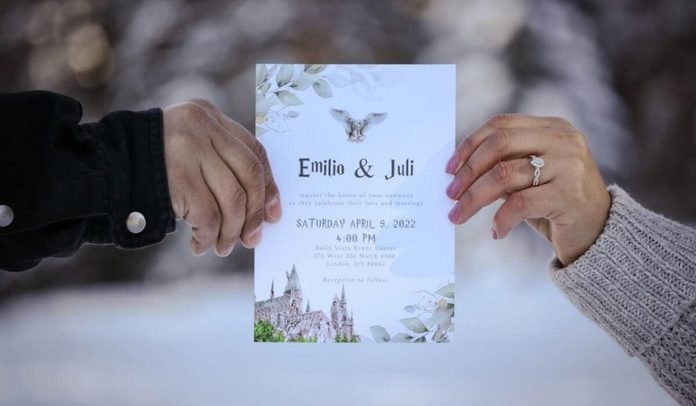
An RSVP deadline looks like one small line on a wedding invitation. In practice, that date controls the caterer’s count, the number of tables and chairs, the seating plan, place cards, meal markers, transport, welcome bags, and sometimes the final venue payment.
Set it too late and every unanswered invitation becomes an emergency. Set it unnecessarily early and guests may not know their work, travel, or childcare plans well enough to answer honestly.
The familiar advice to request replies about a month before the wedding is a useful starting point, not a rule for every celebration.
A local dinner for 60 people and a destination weekend for 180 do not need the same response window. The couple’s real deadline should come from the professionals who need the final information—and it should leave the couple time to follow up before those professionals are waiting.
This timeline begins with the wedding date and works backward. It covers save-the-dates, invitation timing, paper and online replies, international guests, missing responses, and the point when the list needs to be closed.
The RSVP timeline at a glance
| Time before the wedding | RSVP-related task | What couples often overlook |
|---|---|---|
| 12 months or more | Set the guest limit and ask vendors for their final-count deadlines | The venue’s capacity, budget limit, and invitation count are three different numbers |
| 8–12 months | Send destination or travel-heavy save-the-dates | Anyone receiving one should be firmly on the invitation list |
| 4–8 months | Send save-the-dates for most local weddings; begin the invitation system | Gathering correct names and household details takes longer than choosing paper |
| 4–5 months | Confirm reply questions, wording, addresses, and stationery quantities | Meal choices, guest names, event attendance, and accessibility information need separate fields |
| 10–12 weeks | Send destination, international, or travel-heavy invitations where this timing suits the event | Check actual delivery times and give guests usable accommodation information |
| 6–10 weeks | Send most local wedding invitations | A save-the-date does not replace a formal invitation or RSVP request |
| About 4 weeks | Use the RSVP deadline for many local weddings | The date may need to be earlier if vendors or printed materials require it |
| First days after the deadline | Audit the list and contact non-responders directly | Paper cards, spam folders, and replies sent to a parent may explain some gaps |
| 2–3 weeks | Close the list, finish seating, and submit counts as required | Attendance, meals, children, plus-ones, transport, and event-specific counts must agree |
| Final week | Share controlled updates and prepare for true last-minute cancellations | Do not rebuild the room every time one guest changes plans |
These ranges are planning guides. Postal systems, venue contracts, cultural celebrations, school holidays, peak travel periods, and destination requirements can all shift them. The most reliable date comes from working backward from the obligations attached to the couple’s own wedding.
Start with the final-count deadline, not the invitation design
Before choosing an RSVP date, ask every relevant professional when each piece of guest information becomes fixed.
The caterer may need a final number ten business days before the wedding.
The rental company may need table quantities earlier.
A stationer printing a large escort display may need approved names and table assignments two weeks ahead. The venue may ask for meal selections, children’s meals, vendor meals, accessibility notes, and guest accommodation details on separate dates.
Collect the deadlines in writing. If two suppliers give different dates, plan around the earliest one that depends on guest responses. Then add a follow-up buffer—usually at least several days, and preferably one to two weeks when the guest list is large or the RSVP method involves international post.
A simple way to calculate the RSVP date
Suppose the caterer needs final choices 14 days before the wedding, the stationer needs the seating file 12 days before, and the planner wants the final table plan 10 days before. The caterer’s deadline comes first. The couple might place the RSVP deadline four weeks before the wedding, leaving about two weeks to locate missing replies, correct meal selections, and finish seating before the caterer’s count is due.
Now change one fact: the venue requires rooming and transport numbers six weeks ahead for a destination celebration. A four-week RSVP deadline no longer works. The responses need to close earlier, and the invitations must be sent early enough that guests have a fair decision window.
The guiding formula is:
Earliest vendor deadline + follow-up time + time for seating and corrections = the couple’s RSVP deadline.
Do not set the date so early that guests are being asked to predict plans they cannot reasonably know.
If a vendor requests numbers unusually far in advance, ask what can still change afterward, what financial commitment becomes fixed, and whether a small adjustment window exists.
Eight to twelve months before: build the list guests will actually receive
Set the guest ceiling and invitation rules first
The RSVP process becomes messy when the guest list is still negotiating with itself. Agree on the maximum number of people the venue and budget can support, then decide how partners, plus-ones, children, colleagues, family friends, and reciprocal invitations will be handled. Apply the rule consistently enough that it can be explained without inventing a new reason for each household.
Count people, not invitation envelopes. One invitation to two adults and three children represents five potential seats.
A guest invited “and guest” represents two. Vendor teams and the couple are often counted differently for catering and venue purposes, so keep them in the wider event count without mixing them into the invited-guest response rate.
Create one master record for every invited person. Useful fields include the preferred full name, household, postal address, email, phone number, events invited to, named partner or plus-one permission, child status, save-the-date status, invitation status, response, meal choice, and table assignment. A tidy list now prevents later detective work.
Send save-the-dates only to definite guests
A save-the-date is not a casual announcement. It tells the recipient to reserve the date because an invitation is expected. Do not send one to somebody the couple may remove if the budget tightens or a more desired guest becomes available.
For many local weddings, save-the-dates are sent around four to eight months ahead. Travel-heavy dates, popular holiday weekends, remote locations, and destination celebrations often justify eight to twelve months or more. The right timing gives guests useful notice without asking them to hold a vague date before the location and guest list are credible.
Include the date, city or general destination, the couple’s names, and a wedding website if it already contains reliable information. Do not publish an unfinished room block or transport promise. Guests make real financial choices from early information, so label developing plans honestly.
Give international and destination guests more than a date
Guests crossing borders or travelling a long distance may need time for leave from work, passports, visas or entry permissions, flights, accommodation, childcare, and a longer household budget. Early notice is courteous, but early notice must also be useful.
Share the destination, likely event window, official accommodation information, nearest practical transport points, and the date when fuller details will follow.
Guests should verify their own travel requirements through current official sources; the couple should avoid presenting informal travel advice as a guarantee.
If the couple needs an early estimate for a room block or group activity, call it an estimate—not the formal RSVP. A guest who says “we hope to come” ten months out has not necessarily accepted the invitation. Keep preliminary interest and final attendance in separate fields.
Five to three months before: design the response system
Choose paper, online, or a genuine hybrid
Paper response cards feel traditional and are easy for guests who prefer post. Online RSVPs are fast, easier to export, and can show follow-up questions only to the households that need them. A hybrid can serve both groups, but only if all replies enter one master list.
If guests can respond by card, website, email, or phone, designate the person who records every channel.
A parent’s text saying “Aunt June is coming” should not live outside the RSVP system.
Add the date, source, and person who supplied the answer in case details later conflict.
Test the process from a guest’s point of view. Search the online form using a formal name, nickname, accented name, and household partner. Try it on a phone. Submit a decline. Add a permitted guest. Check the confirmation message. For paper cards, verify the return address, postage requirements, print legibility, and the way households are identified if handwriting is difficult to read.
Ask only for information that has a purpose
A response needs to confirm attendance first. After that, collect only details the couple or vendors will use: the attending person’s name, accepted events, meal selection where required, the name of an invited guest, transport interest, and a clear way to share relevant accessibility or dietary information.
Separate attendance by event for a multi-day wedding. A guest may attend the ceremony and reception but not the welcome dinner, or accept the wedding while declining the next-day brunch. One household-level “yes” cannot supply those counts.
Phrase meal options as choices guests can recognise. “Beef, fish, vegetarian” is clearer than poetic menu names with no explanation.
Ask the caterer exactly what information is needed and how children’s or supplier meals are counted. Do not ask every guest to design a custom menu through an open text box.
If requesting accessibility information, make the invitation welcoming and practical: invite guests to share what would help them take part comfortably, provide a private contact route, and pass relevant details only to the people arranging access or service.
Choose an RSVP deadline guests can understand
Use a full written date rather than “reply within three weeks.” On paper stationery, make the deadline easy to find near the response instruction. On a website, repeat it on the RSVP page and confirmation message. Guests should not have to search the travel page to discover when an answer is due.
For many local weddings, a deadline around three to five weeks before the date creates a workable balance.
Destination events, early supplier cutoffs, complex transport, or custom printed seating pieces may require six to eight weeks or another carefully calculated date.
An earlier deadline also means invitations must go earlier; guests still need a fair amount of time to receive the invitation and decide.
Avoid setting the deadline on a major holiday or the day after a long weekend. Choose a weekday when the couple can audit responses and begin follow-up. If the caterer needs numbers on a Monday, an RSVP deadline the previous Sunday provides no real buffer.
Order stationery with the whole response chain in mind
Invitation production is part of the RSVP timeline. Custom artwork, specialty printing, calligraphy, assembly, and international delivery can require several weeks. Confirm production and shipping estimates before promising a mailing date.
Order enough invitations for households, not headcount, plus a sensible number for address errors, late corrections, keepsakes, and any genuinely planned later additions. Extra envelopes are especially useful because one incorrect address should not require a complete stationery reorder.
Take one fully assembled invitation to the postal service or carrier being used and check its size, weight, thickness, and postage. Square envelopes, wax seals, ribbons, rigid inserts, and multiple cards can change cost or handling.
Do the same for a response envelope if the couple is providing postage, particularly for guests replying from another country.
Twelve to six weeks before: send invitations and watch delivery
Use the wedding’s travel demands to choose the mailing window
Traditional guidance often places local invitations around six to eight weeks before the wedding. Many modern couples use a slightly wider six-to-ten-week range, especially when guests are travelling within a large country or the response system asks for several event choices. Destination and international invitations are commonly sent around ten to twelve weeks ahead or earlier when the event logistics require it.
Earlier is not automatically better. An invitation sent many months ahead can be misplaced, and guests may treat the formal response as something to handle later.
Save-the-dates carry the early notice; invitations should arrive when the information is stable and the RSVP deadline feels real.
No save-the-date was sent? The invitation may need to go earlier than the standard local window, particularly for guests who must travel. Contact the most affected people personally as soon as the date is firm rather than relying on a late envelope to provide the first notice.
Track invitations as sent, delivered, returned, or uncertain
Record the mailing or send date for each household. For digital invitations, watch delivery failures and ask guests to check spam only when there is evidence of a problem; do not assume opening data is perfectly accurate. For paper, monitor returned envelopes and correct addresses promptly.
If one invitation returns, contact that household directly. If several return from the same area, investigate the mailing format or local disruption before sending replacements. Do not wait until the RSVP deadline to discover that a postcode, apartment number, or country line was omitted.
A save-the-date that arrived successfully does not prove the invitation reached the same address months later.
People move, separate, change names, or travel for long periods. The master list should preserve the current address and the history of any correction.
From the first reply to the deadline: maintain one clean source of truth
Record the response at person level
A household may return one card, but the wedding needs to know what each person is doing. One partner may attend while the other declines. A named child may join the reception but not a late-night event. Meal choices also belong to individuals, not envelopes.
Enter responses soon after they arrive. Check that the number attending does not exceed the number invited, the plus-one name is permitted, and every requested choice is complete.
Contact the guest while the invitation is still fresh if something is unclear.
Keep a visible status for “accepted but incomplete.” It is not the same as a complete RSVP. If 120 people have said yes but 18 have no meal choice and six have not named their guests, the catering and stationery work is not finished.
Send a reminder without treating punctual guests like offenders
A broad reminder about one week before the deadline can be helpful, particularly through a wedding website or digital invitation system. Keep it practical: repeat the date, response link, and contact for difficulty. Do not announce how many people have failed to reply or shame guests publicly.
“A quick reminder that replies for our 14 September wedding are due by Friday, 9 August. You can respond at our wedding website. If the form gives you trouble, please message Sam directly.”
Send targeted reminders only to people whose responses are genuinely missing. A guest who mailed a card yesterday may still receive one, which is another reason to keep the tone neutral.
Couples using post can allow a brief delivery margin after the date, but should not let that margin run into the supplier deadline.
The day after the RSVP deadline: audit before chasing
First, reconcile every channel. Check the website dashboard, response cards, spam folder, shared planning email, messages to both partners, and replies parents may have received. Confirm that a partner has not entered a household under a nickname or duplicate record.
Then make a non-responder list and assign one contact person per household. The person with the natural relationship should usually reach out: one partner contacts her friends, the other contacts his relatives, and a parent may call an elderly family friend.
Central tracking still matters; otherwise two people may contact the same guest with different deadlines.
Ask for a definite answer and give a short final date that remains safely before the vendor cutoff:
“Hi Lena, we’re closing the guest count for our wedding and don’t have your reply yet. We’d love to have you if you can make it. Could you let me know yes or no by Thursday evening? If I don’t hear from you, I’ll need to record that you can’t attend.”
This is not rude. It gives the guest a clear choice and prevents the couple from paying, seating, and ordering for somebody who has not accepted. The couple should not submit an unanswered invitation as a yes “just in case.”
Two to three weeks before: close the list and reconcile every count
Once the final response window ends, mark unresolved invitations as not attending and send a brief confirmation if needed. Then compare the master list with every downstream count.
The total number attending the reception may not equal the number eating each meal, using transport, attending brunch, requiring a highchair, or receiving a place card.
Reconcile these groups separately:
- Adults, children, and babies according to the venue’s counting rules
- Each meal choice and any caterer-approved special meals
- Couple, wedding party, vendors, performers, and other supplier meals
- Ceremony seats and reception seats if attendance differs
- Welcome event, rehearsal-related event, and brunch attendance
- Shuttle seats, accessible transport, or parking reservations
- Place cards, escort cards, menus, favours, welcome bags, and rentals
Send vendors a dated version and identify the person authorised to update it. A text saying “we think it is 126 now” is not a final count. Written, labelled information protects both the couple and the vendor from working with different numbers.
Begin seating early, but finalise it only with confirmed guests
Couples can sketch social groups while replies arrive: immediate family, extended family, school friends, colleagues, and guests who know very few people. Do not print a seating display or force exact tables around people who have not responded.
Use the venue’s real floor plan and table capacities. “Ten people fit at a round table” may be true for one table size and uncomfortable for another, especially with chargers, elaborate centrepieces, highchairs, mobility devices, or service space. Confirm capacities with the venue or rental team.
Leave room for operational adjustment without designing an obviously empty “spare” table. One late cancellation often means removing a place setting, not moving three complete households.
Give the coordinator the final layout and the rule for handling a last-minute change.
How the timeline changes for different weddings
A short engagement
When the wedding is less than three months away, skip the traditional separation between save-the-date and invitation.
Contact essential travellers immediately, finalise the guest list, and send the complete invitation as soon as reliable event details are ready.
Use a fast response method and a clearly explained deadline. A digital invitation or online RSVP may be practical, but call guests who are less comfortable online. The couple still needs a follow-up buffer; shortening the engagement does not make vendor deadlines disappear.
A destination or multi-day wedding
Send useful early notice and calculate the formal RSVP date from accommodation, transport, group-event, and vendor commitments. Collect attendance for each hosted event rather than assuming every traveller will join everything.
Do not demand a formal commitment before guests have basic cost and schedule information. If the resort block has a separate booking deadline, display that date separately from the wedding RSVP deadline. Booking a room may indicate intent, but it should not silently replace the couple’s guest record.
A small wedding
A guest list of 20 still needs replies. Small weddings often have fixed private-room minimums, detailed tasting menus, or limited ceremony seating, which makes one unanswered household proportionally significant.
Personal follow-up may feel more natural than an automated sequence. Keep the same clarity: invited names, response date, meal information, and a final answer. Closeness is not a substitute for confirmation.
A wedding across several cultures or languages
Invitation customs, family roles, naming formats, and the meaning of a household invitation can vary.
Ask knowledgeable family members about genuine cultural expectations, then translate the couple’s attendance rules into direct, respectful wording.
Provide translated guidance where it will prevent confusion, and offer a phone contact for relatives who will not use the main RSVP method. Keep one person-level master list even if replies arrive through several family channels.
Common RSVP timeline mistakes—and the better decision
| Mistake | Why it causes trouble | Better approach |
|---|---|---|
| Using the caterer’s due date as the guest deadline | There is no time to chase missing replies or correct choices | Place the guest deadline at least several days—and preferably one to two weeks—earlier |
| Sending save-the-dates before the list is firm | Recipients reasonably expect formal invitations | Send only to guests the couple is committed to inviting |
| Treating one household reply as complete | Individual attendance and meal information can be missed | Track every named guest separately inside the household |
| Offering too many reply channels without one recorder | Texts, cards, and website replies produce conflicting lists | Welcome several channels but enter every reply in one master file |
| Printing seating before follow-up ends | Late corrections become expensive reprints | Design early, approve names and tables after the list closes |
| Assuming silence means yes | The couple pays and plans for guests who never accepted | Follow up directly, set a final cutoff, then record no response as not attending |
The timeline should protect the final weeks
A good RSVP date is generous to guests and useful to the people producing the wedding. It gives invited households enough information and time to answer, then gives the couple enough distance from vendor deadlines to handle the inevitable missing card, unnamed plus-one, or incomplete meal choice without panic.
Once the final list is reconciled, close it. The last weeks should be used to welcome the people who are coming—not to keep negotiating with invitations that were never accepted.