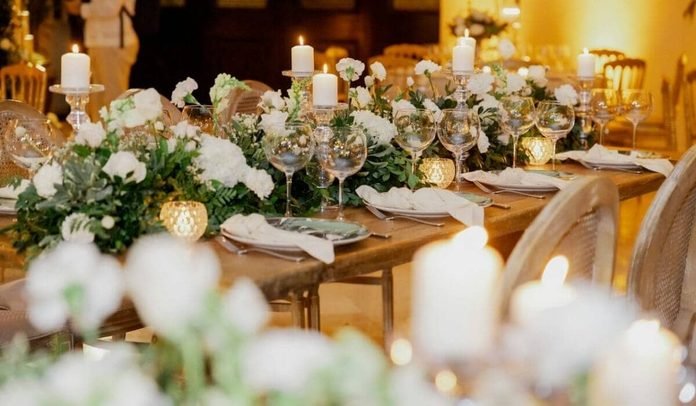
A reception rarely feels slow because dinner itself takes too long. It feels slow because guests are asked to sit before the room is ready, five speeches appear between courses, and the dance floor opens just long enough for one song before cake cutting stops it again.
The strongest reception timeline has a simple rhythm: guests move with purpose, food is served when the kitchen intends, formal moments are grouped, and dancing receives enough uninterrupted time to become a party. The couple still gets the traditions they care about. They just stop making every tradition its own event.
This sample assumes a 5:30 p.m. cocktail hour, seated dinner, several short toasts, and an 11 p.m. finish. Buffet, food-station, cultural, and shorter-reception adjustments appear below.
The clock times are an example, not a template to copy unchanged. Your caterer’s service plan, the venue’s curfew, the number of speakers, and the kind of party you want should decide the final shape.
The sample reception timeline
| Time | Guest experience | Couple and production | Why it works |
|---|---|---|---|
| 5:30 p.m. | Cocktail hour begins with seating, drinks, and food ready | Family portraits; room reset continues | Guests enter a hosted event, not a holding area |
| 6:10 p.m. | Cocktail service continues | Couple eats privately, refreshes, bustles, and sees the room | The couple reaches dinner composed |
| 6:20 p.m. | Guests are invited to find seats | Caterer, MC, and planner confirm readiness | Seating is a transition, not an instant cue |
| 6:35 p.m. | Wedding party and couple enter; brief welcome follows | Kitchen receives the agreed service cue | The opening programme stays under fifteen minutes |
| 6:50 p.m. | Dinner service begins | Couple eats; supplier meals are served as contracted | Food is not held behind formalities |
| 7:40 p.m. | Two or three planned toasts | Service pauses or clearing follows the caterer’s plan | Speeches have a defined window |
| 8:05 p.m. | First dance and selected parent dances | Band or DJ moves directly into an inviting floor-opening song | Formal dances create momentum |
| 8:20 p.m. | Open dancing | Bar and entertainment continue without announcements | The floor has time to build |
| 9:15 p.m. | Brief cake or dessert cue | Catering serves dessert while music resumes | The interruption remains short |
| 10:30 p.m. | Last call and transport reminder | Personal items and departure owners receive cues | The end does not begin at the curfew |
| 10:50 p.m. | Final dance or private last dance | Exit and cleanup teams move into position | The evening lands instead of stopping abruptly |
Set the four reception anchors before filling in the fun parts
Begin with the time guests can enter cocktail hour, the earliest realistic dinner service, the point at which dancing should open, and the venue’s true finish. “Venue ends at 11” needs clarification. Does music stop at 11, must guests be off-site by then, or must every vendor complete breakdown by then? Those are very different timelines.
Ask the caterer how dinner works for your menu, guest count, room, and staffing.
Ask the entertainment team about setup, sound limits, band sets, breaks, and the latest possible final song.
Add photography or video coverage limits and transport departures. Only then place entrances, speeches, dances, cake, outfit changes, games, cultural traditions, or an exit.
This order prevents a familiar problem: the couple chooses an hour of formalities, then discovers the kitchen needs to serve during it and the band is due for a break just as dancing should begin.
Cocktail hour needs a real job and a real guest experience
Cocktail hour may cover portraits, guest travel, a room flip, and the couple’s bustle or touch-up. Ask the venue and photographer how long those jobs take before promising a 60-minute period. Seventy-five minutes can be more honest than an “hour” that quietly becomes ninety.
Guests need seating, enough bar capacity, food that circulates, open facilities, weather protection, and a clear transition. Long queues make a normal cocktail hour feel delayed. A second service point or non-alcoholic station can improve flow more than entertainment added to distract from waiting.
Protect the final fifteen or twenty minutes for the couple. They can eat a small plate, use the bathroom, bustle or change, and take in the reception room.
Do not spend that pause on another portrait combination unless the couple actively chooses the trade.
Do not invite guests to sit before dinner can move
Finding escort cards, greeting tablemates, settling children, and moving through one entrance can take fifteen minutes.
Begin seating when the room, caterer, MC, and couple will be ready soon—not because cocktail hour has reached an arbitrary end.
If guests are seated twenty minutes before an entrance and another twenty before food, the reception feels stalled. Offer bread, salad, or another planned service only if the caterer supports it; otherwise keep guests comfortably in cocktail hour until the room is ready.
The planner should give one seating cue. Staff begin directing guests, the bar handles its agreed transition, and the entertainment lead changes the music. Several relatives announcing “I think we’re going in” create a slow, uneven move.
Keep the grand entrance from becoming a full show before dinner
Introducing twelve wedding-party pairs to twelve different song clips can use far more time than the timeline suggests.
The couple can enter alone, the party can be announced as a group, or introductions can remain simple.
If the first dance happens immediately after the entrance, follow it with a short welcome and service. If the couple prefers to dance after dinner, enter, welcome the room, and sit. Both structures work. Trouble begins when entrance, dance, blessing, parent welcome, couple speech, and a surprise video all sit between guests and food.
Give the kitchen the exact pre-dinner sequence and a person authorised to cue service. “Dinner around seven” is not enough when hot plates depend on a five-minute decision.
Let the catering style control the dinner schedule
Do not choose a generic “90 minutes for dinner” and make the caterer fit inside it. Service time depends on the number of guests, courses, service points, walking distance from the kitchen, staff, and how many events interrupt the meal. Ask for a service sequence rather than one broad duration.
For a plated meal
Ask how long each course takes to serve and clear for the actual guest count, staffing, and room. Place speeches in a window the caterer approves. A toast during active plate delivery is hard to hear and difficult to photograph; an unexpected ten-minute speech can leave the next course waiting.
If guests pre-selected meals, confirm how choices will be identified at the table. If orders are taken on the night, allow for that service.
Dietary meals also need a clear delivery system that does not rely on the couple answering questions during dinner.
For a buffet
The first table eating and the last table reaching food can be separated by a long period.
Ask how tables are released, how many buffet lines operate, and when the couple eats. Opening the buffet before a lengthy welcome prevents guests staring at food they cannot approach.
Announcements should be audible but brief. Guests need to know whether both sides of a buffet are active, whether children or particular tables should go first, and where plates are found.
A coordinator or catering lead should release tables; asking the DJ to guess can create a queue the room cannot hold.
For food stations or family-style service
Stations create movement; family-style requires serving pieces and passing. Both need room and time. Do not schedule speeches while most guests are carrying plates or trying to hear service instructions. The caterer’s plan should describe the guest journey, not only the menu.
Stations may open in stages, and a table can run low while another has no line.
Family-style platters need landing space, replenishment, and a plan for tables with children or access needs. Walk through those details before using a plated-dinner schedule for a completely different experience.
Put toasts where people can listen and food can survive
Choose the speakers before the wedding and give each a clear limit. Three five-minute speeches still need introductions, applause, and transitions, so a 20- to 25-minute block is realistic. Unscheduled speakers belong at a rehearsal event or private moment unless the couple explicitly opens the microphone.
A welcome of one or two minutes can happen before dinner. Longer personal toasts often work between courses or near the end of the meal, according to catering. Avoid splitting speeches into several small sets that repeatedly stop conversation.
The MC or entertainment lead should hold the order and microphone. Speakers need to be present, briefed, and near the speaking position before the cue. Looking for a missing uncle while guests wait feels much longer than the search actually takes.
Tell speakers their time limit before the wedding, not as they are handed the microphone. A useful brief covers the limit, order, speaking location, and any topics the couple wants kept private. It is fair to ask for a short written copy if the speaker is anxious or known for improvising; the point is support and timing, not editing every affectionate word.
Build a small amount of overrun into the speech window, but do not advertise it. If every speaker uses the extra five minutes, the meal or dance floor pays for it. One named MC should be comfortable closing the set warmly and moving the room forward.
Open the dance floor once—and let it stay open
Formal dances are most useful when they lead directly into guest dancing. Shorten songs or combine parent dances if that feels natural. The band or DJ should have an energetic bridge ready so guests understand the floor is now theirs.
Protect at least one long early block. A dance floor opened at 8:20 and stopped at 8:35 for cake never has time to gather. Move cake before the formal dances, pair it with dessert service later, or keep the cutting brief and let music continue.
Band breaks require planning. A DJ playlist or secondary music can maintain energy, but a break immediately after the floor opens works against the room. Ask the band when breaks must occur and build formalities into those quieter periods where possible.
The room layout matters too. Guests are more likely to join if they can see the floor, reach it easily, and leave their seats without navigating tables. A dance floor in a separate room may need a stronger invitation: formal dances there, immediate upbeat music, the bar nearby if permitted, and the couple staying on the floor for the first few songs.
If a full dance party is not the goal, do not manufacture one. A brunch, restaurant reception, or small dinner may flow better with live background music, a short first dance, and conversation. “Keep dancing moving” means protecting the experience the couple chose, not forcing every reception into a nightclub structure.
Cake cutting is a cue, not a compulsory performance
The public cutting may take five minutes; slicing and serving takes longer. Coordinate photography, catering, and music. If cake is plated for dessert, cutting earlier can give staff time to prepare it.
Older guests may treat cake cutting as the final major formality and feel comfortable leaving afterward. That can be useful. It also means couples should not place a deeply meaningful tradition later if they expect those guests to remain.
No cake? Dessert can arrive without a formal announcement. The reception does not need a substitute ritual simply because a sample timeline includes one.
Protect the couple’s dinner
Serve the couple promptly and let them eat. Do not schedule table visits, sunset portraits, a clothing change, and three speeches across their entire meal. Coordinate any departure with the caterer so their plates are not placed while they are outside.
Table visits are not quick at a large wedding. If greeting every table matters, ask the planner how many can be visited between courses without holding service. A receiving line or deliberate cocktail-hour greeting may suit the guest count better.
Supplier meals also need a workable point. Photographers cannot eat during speeches or formal dances they are expected to cover.
Plan their service with the caterer and coordinator rather than sending food after every key event is finished.
Place outfit changes and sunset photographs where they cost the least
An outfit change can use fifteen to thirty minutes after the couple reaches the room. Add walking, a helper, shoes, accessories, and touch-up. Schedule it during a natural guest period, not at the moment dancing finally gains energy.
Sunset portraits should use the real seasonal light and include travel to the location. The photographer may need ten minutes of shooting and twenty minutes of movement. Coordinate with dinner and decide what is removed if service runs late.
Both are optional unless they carry cultural or personal meaning. They should not automatically take time from eating or greeting guests.
Give cultural traditions enough room to feel meaningful
A tea ceremony, blessing, formal presentation, group dance, outfit change, or other family tradition should not be labelled as another five-minute reception activity without speaking to the people who understand it. Ask what preparation is needed, who participates, whether elders should still be present, and what guests need explained.
Some traditions work before dinner because they welcome or bless the couple. Others are naturally celebratory and can launch dancing.
Several may belong at a separate ceremony or earlier gathering. There is no universal placement; cultural and religious practices vary between families as well as communities.
Once the couple decides what carries real meaning, protect those moments and simplify lower-priority reception extras around them. A thoughtful ten-minute introduction and performance will feel better than three important traditions rushed into a single generic “formalities” block.
How to adjust a four-hour reception
A shorter reception needs fewer stops. Keep cocktail hour separate where possible, begin dinner soon after entry, limit speeches, group formal dances, and cut cake without pausing the room for a long presentation.
If dancing is the priority, work backward from at least two hours of open floor time. This may mean a simpler meal, earlier ceremony, shorter programme, or later venue end. A four-hour reception cannot hold a two-hour dinner, an hour of speeches and traditions, and a three-hour party.
| Main priority | Protect in the timeline | Simplify first if time is tight |
|---|---|---|
| A long dance party | One early opening and a substantial uninterrupted block | Individual entrances, many speakers, separate cake announcement, table visits |
| A leisurely dinner | Course pacing, conversation, and a comfortable speech window | Early dance-floor deadline, several post-dinner games, elaborate staged exit |
| Family and cultural moments | The right participants, explanation, setup, and meaningful duration | Generic reception traditions that do not matter to the couple |
| Guest conversation | Cocktail seating, dinner time, manageable sound, and fewer announcements | Back-to-back entertainment and a packed formal programme |
Plan the final half-hour before it becomes an evacuation
Last call, transport, a final dance, an exit, personal-item collection, and vendor breakdown all compete near the end.
Work backward from the contractual deadline. If guests must be out by 11 p.m., the final song cannot begin at 10:59 while coats are still checked and shuttles are unboarded.
Decide whether there will be a public exit, a private last dance, both, or neither. Staging every guest outdoors can take twenty minutes and may empty the dance floor early. A small send-off with the wedding party or an unannounced departure may preserve more of the party.
Venues also have rules about candles, petals, confetti, sparklers, and cleanup, so the visual should be approved before it goes on the schedule.
Name the people taking cards, gifts, marriage documents, clothing, cake, flowers, and personal décor. Their instructions belong in the production plan before the reception. The couple should not spend the final song deciding whose car has room for the card box.
The final timeline needs three owners, not one vague promise
The planner controls movement and readiness. The caterer controls food service. The MC, DJ, or bandleader controls public cues. They should agree on the same dated timeline and know who has final authority if one part shifts.
If dinner is ten minutes late, the planner may move speeches or shorten an optional cue. The couple should not negotiate kitchen timing from the head table. A strong reception can flex because the people in charge know what to protect: food quality, guest comfort, and the uninterrupted party.
The reception should gather momentum, not keep restarting
Guests are happy to listen, watch, eat, and dance. They become tired when every transition contains a wait and every burst of energy is stopped for another announcement.
Feed them when they sit, keep toasts intentional, and open the floor with enough evening left to enjoy it.
A reception feels effortless when the production is disciplined enough to disappear.